
- My booking
- Online Check-in
- Flight extras
- Financial services


 Booking
 Skyshop
 Hotel
Hotel
 E-Voucher
 E-Sim
E-Sim
 E-Visa
 Buy foreign currency
 Insurance
 SkyJoy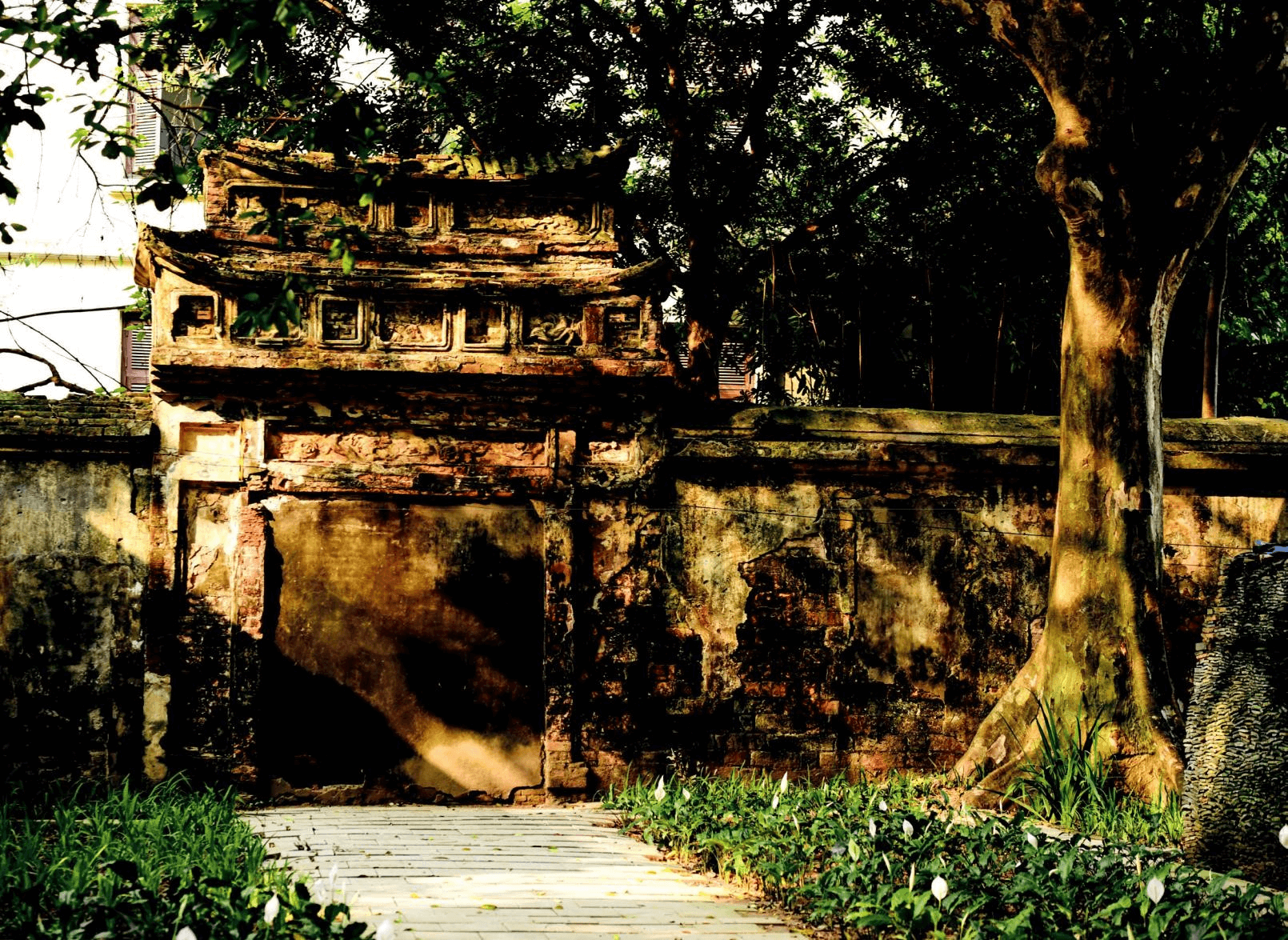




Departure date

Return Date

Ha Noi
THE IMPERIAL CITADEL OF THANG LONG
Over 1,000 years ago, the Vietnamese ruler Ly Cong Uan (Ly Thai To) moved his capital to a new site in the Red River Delta. The capital would be named Thang Long (Ascending Dragon) and thankfully parts of it still stand today.
At 20:30 on July 31st, 2010 in Brasilia Capital of Brazil, UNESCO’s World Heritage Committee approved a resolution to recognize the Imperial Citadel of Thang Long in Hanoi as a world heritage with outstanding values, namely, its cultural and historical longevity, its continuous role as a seat of power, and multilayered cultural significance.
The citadel stood the test of time to become the center of national politics, economy, culture, creativity, and intellectual thought. The citadel also nurtured and maintained many of the cultural traditions from the Red River delta and beyond through history. It is truly a cornerstone of Vietnamese civilization.
When I first stepped into Imperial Citadel of Thang Long during my trip to Hanoi, I thought of the lyrics from a song written by Nguyen Dinh Thi, a talented musician, which seemed to capture my emotions: “Souls of mountains and rivers kept here for thousands of years”.
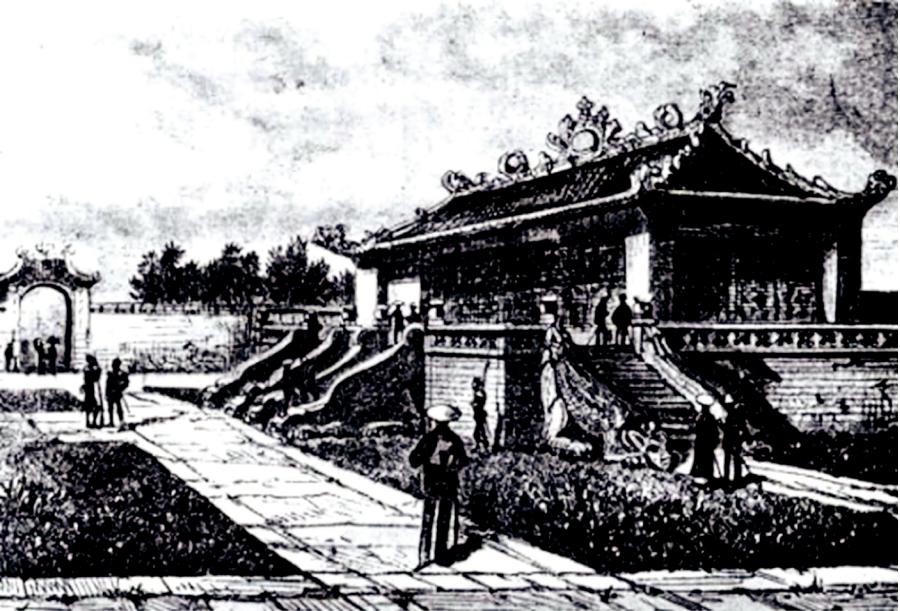
It’s incredible to think that over 1,000 years ago, King Ly Cong Uan (later named Ly Thai To) decided to move the capital from Hoa Lu to the west of present-day Hanoi. The king had a strategic vision in mind. He wanted a citadel to be located among rivers with the dream of creating a “long-term dynasty, rich and prosperous customs”.
When founding his new capital, King Ly Thai To wrote in a decree that Dai La Citadel is located in the middle of sky and earth, and its location evokes the image of a rolling dragon, a squatting tiger, and that the site is sufficiently vast and level, the grounds sufficiently raised and well exposed. It was deemed to be the most prosperous land.
So after leaving Hoa Lu, King Ly Cong Uan quickly constructed a new citadel on the foundation of the ancient Dai La Citadel. As for the name Thang Long, according to the "Complete Annals of Dai Viet": “In July of 1010 (Year of the Dog), the King moved the capital from Hoa Lu to Dai La Citadel, and when the ship temporarily stopped under the Citadel, a golden dragon appeared on the King’s ship, and so the name of Thang Long (Ascending Dragon) has been used since then”.
Thang Long Citadel was built with three enclosed citadels. The outer ring is called La Citadel or Citadel and surrounded the whole capital. It was set within three rivers: Red River, To Lich River, and Kim Nguu River. There, in the outer ring, civilians resided. The second ring (middle one) was the Imperial Citadel - the main tidal area, which was where central governmental bodies lived and worked. The smallest and most central ring was the Forbidden City, where only the King and the royal family's residence were located.
After Ly Chieu Hoang (at the age of seven years old) ceded her throne to her husband, Tran Canh, 216 years of rule under the Ly Dynasty came to an end, and the Tran Dynasty began. Work on Thang Long Citadel continued with the restoration of buildings and construction of several other works.
When the Early Le Dynasty held power, the Imperial Citadel retained its prominence and many new constructions were added. From 1516 to 1788, through the Mac and Restored Le dynasties, there were many battles, and Thang Long Citadel was badly damaged many times.
In early 1789, after winning numerous battles, including an audacious triumph over an invading Chinese army, Nguyen Hue renamed himself King Quang Trung decided to move the capital to Phu Xuan, and Thang Long was known as Tran Bac Citadel. Under the Nguyen Dynasty, many of the remaining parts of Thang Long were removed to Phu Xuan where a new citadel was being constructed. Within the original Thang Long citadel, only Kinh Thien Palace and Princess Palace were retained and restored for serving Nguyen Kings whenever they visited Bac Citadel.
In 1805, King Gia Long destroyed the walls of the ancient Imperial Citadel and began building the Hanoi Citadel following the classic "Vauban" style, named after the famous French engineer who became famed for his fortified buildings.
The name “Ancient Hanoi Citadel” first appeared in 1831, when King Minh Mang conducted a large administrative reform, establishing provinces throughout the country, including Hanoi Province. Thus, Hanoi Citadel became the headquarters of Hanoi Province. When Indochina became a French colony, the French chose Hanoi as the capital of French Indochina. However, much of the Hanoi Citadel was destroyed as the French constructed their own offices and barracks.
In 1954, when Vietnam had retained indolence, and the Vietnamese army liberated the capital, the Hanoi Citadel became headquarters for the Ministry of Defence. It can be said that the Center of the Imperial City is a place that has witnessed all the ups and downs throughout the 10-century history of Thang Long - Hanoi from the time of Dai La citadel until now.
KINH THIEN PALACE
Over its long history, time and battles have destroyed much of the citadel, but the remaining relics are enough for us to imagine the scale as well as the cultural and historical values of the Imperial Citadel of Thang Long. We still can visualize the ancient squared citadel, which was built by the Nguyen Dynasty in 1835.
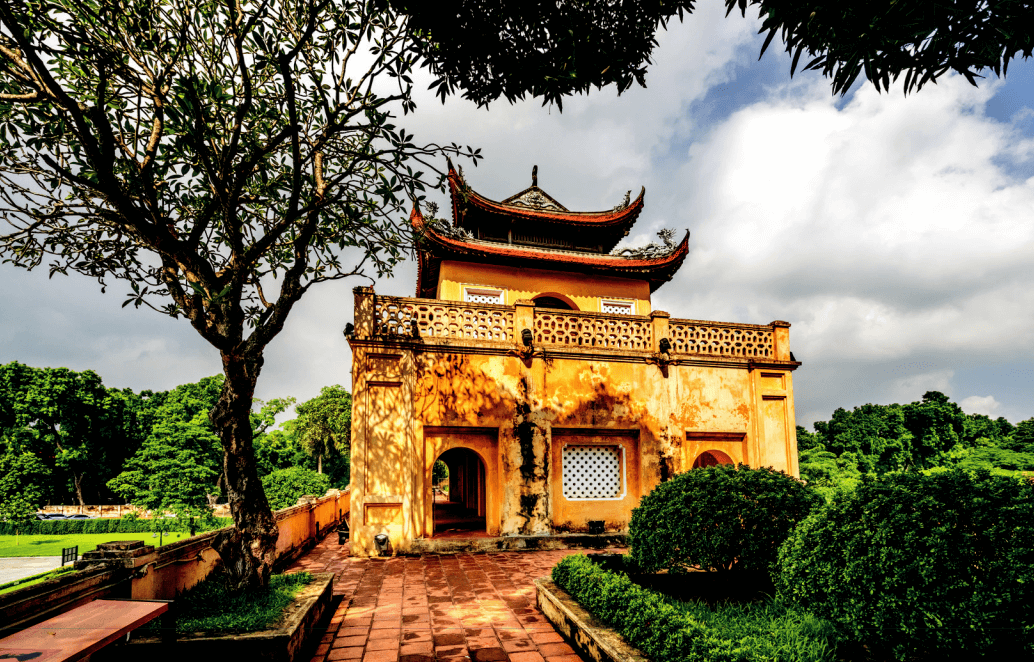
Until now, the names of ancient citadel gates are still being used to name surrounding streets such as North Gate, South Gate, East Gate, Dai La, Duong Thanh. The North gate and East gate still retain several parts of the ancient Hanoi Citadel from 1831. The outstanding architectural work is undoubtedly Ky Dai - Hanoi Flag Tower, which stands over 33m tall. It still keeps its original shape and has withstood the test of time.
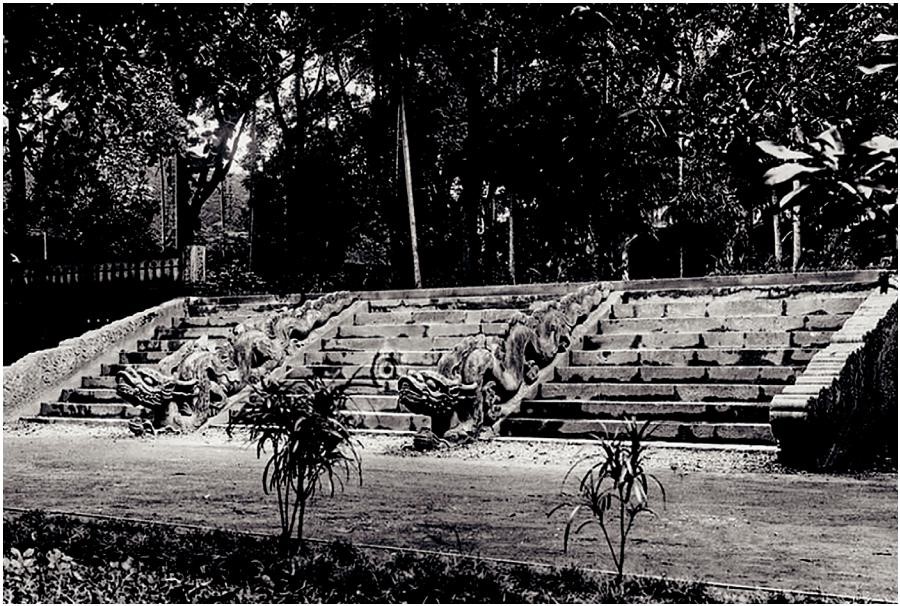
Toward the center of the ancient Imperial Citadel, we can see the relics of architectural works such as the Main Gate (Doan Mon) and Kinh Thien Palace, Princess Palace. Visiting the latter we can still see a pair of monolithic stone dragons that were built during the Le Dynasty in the 15th century. The stone dragons have inspired many poets and writers to write about the nation’s immortal heroes and national pride through the age.
According to the “Complete Annals of Dai Viet”, Kinh Thien Palace was built in 1428 under King Le Thai To’s rule and it was completed under King Le Thanh Tong’s rule. The palace was built on Nung mountain, right on the old foundation of Can Nguyen - Thien An palace in the Ly and Tran dynasties. This is the place where the court held the most solemn rituals, welcomed foreign emissaries, and gave the audience to discuss affairs of state.
The stone dragons at Kinh Thien Palace are a masterpiece of architectural heritage, featuring the typical sculptured art of the Early Le Dynasty. Carved with green stone, each stone dragon has a large protruding head, convex round eyes, long branched horns, and a mane gliding back. Dragon bodies curve softly into many arcs and they are gradually smaller towards the palace platform, on their backs, there are long undulating fins like clouds and sparks.
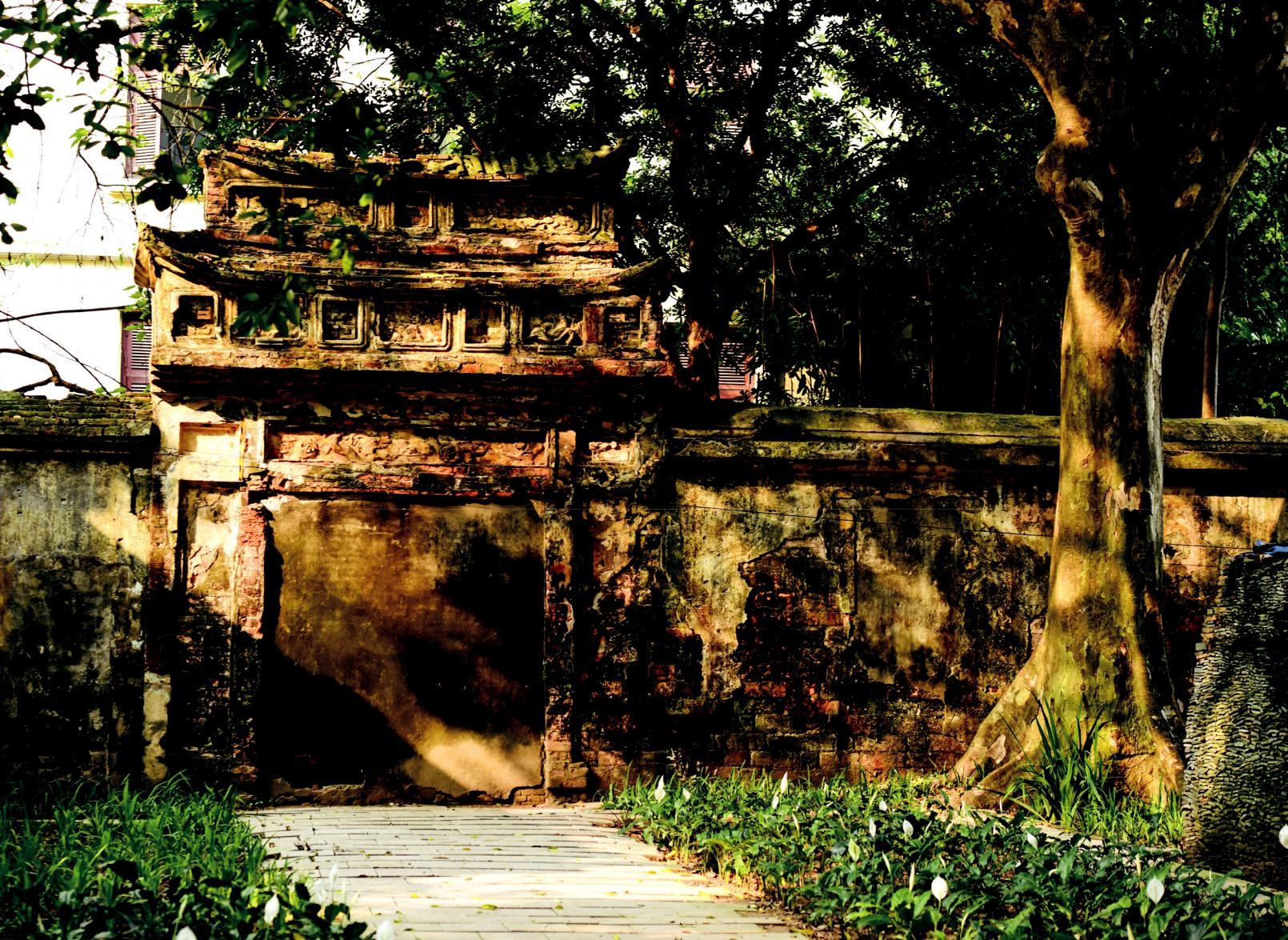
Kinh Thien Palace is the central relic and the main part among the overall historical landmarks of Hanoi Ancient Citadel. The Main Gate is in front of Kinh Thien Palace, then Hanoi Flag Tower, Princess Palace, and North Gate are behind while both the east and the west are covered by walls and small gates. These small gates have been listed along with other relics from the ancient citadel since 1925 by the French Government.
Nowadays, this place has become a relic representing two eras - Kinh Thien Palace belongs to the Ancient Imperial Citadel of Thang Long but also the Vietnam People's Army - and is an important element of Vietnamese modern history.
THE SPRING OX CEREMONY
When celebrating Tea (the Lunar New Year) earlier this year, for the first time, Thang Long-Ha Noi Heritage Conservation Centre coordinated with Thang Long Cultural Heritage Association and Y Van Hien Company to practice the Spring Ox Ceremony, a unique ritual that harks back to the ancient royal court. The ritual takes place on the first day of the solar term, and is performed with a desire to dispel the cold of winter, welcome a new spring, and pray for a bumper crop.
The ritual dates back to the King Ly Anh Tong period (1138-1175) and is performed in honor of Cau Mang (Mang God), the deity who controlled spring, crops, and rain. There had to be an earth buffalo (Xuan Nguu) offered during the ceremony.
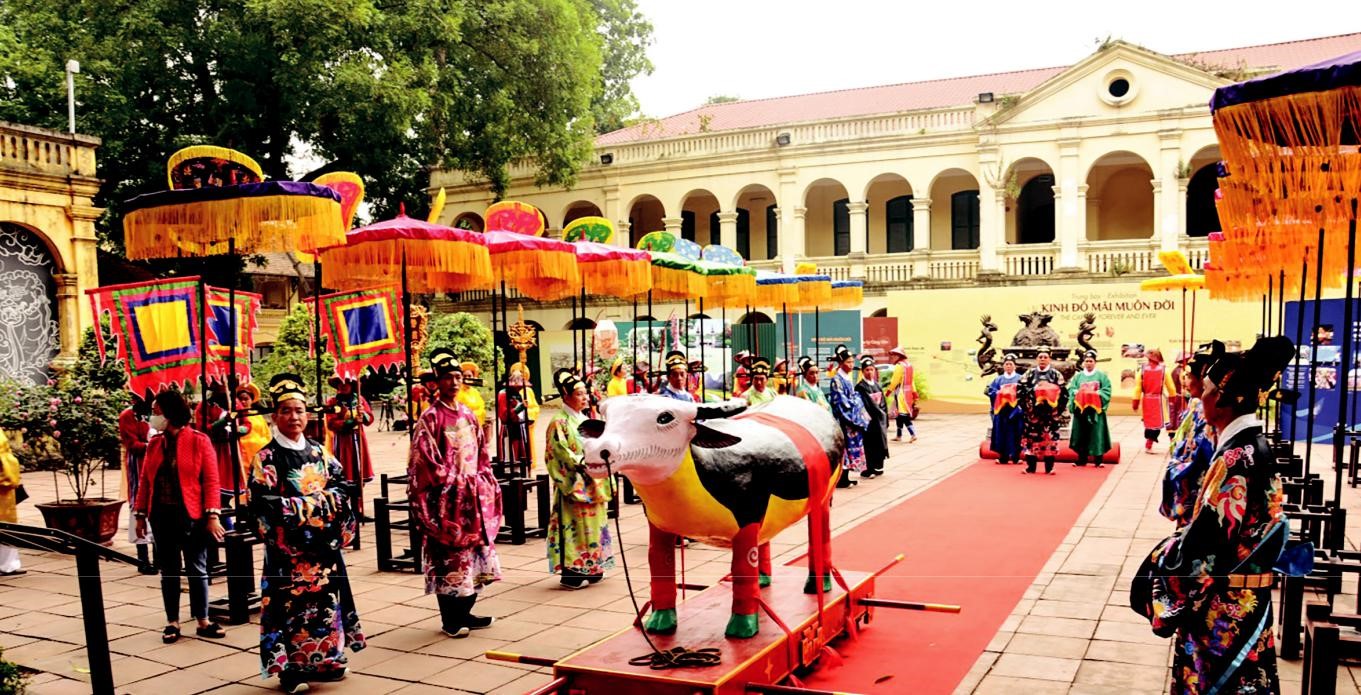
Both the earth buffalo and Mang God had to be covered with earth (using mulberry branches as the base) following the ratios of the sizes and colors corresponding to certain meanings. The buffalo body is regulated to be 4 meters tall, representing four seasons; from head to tail is 8 meters long, representing the eight periods of spring beginning, spring equinox, autumn beginning, autumn equinox, summer beginning, summer equinox, winter beginning, and winter solstice.
Similarly, with those meanings, Mang God (the buffalo herding God) is also made to be 365cm high, symbolizing 365 days. All factors such as facial expressions, clothes, and shoes, etc. on his body are also strictly regulated in terms of features and colors to correspond to yin and yang.
During the ceremony, governors must wear red, or purple clothes walking behind the music team, with the ritual sticks, the halos, the parasols, and the carrying Mang Gods and earthern buffalos to the ceremony house. Under the Le dynasty, Spring Ox Ceremony was held at Kinh Thien Palace with the participation of first-ranking governors of the court and other mandarins. After the ritual ceremony, the ceremony of offering Spring Ox for governors, mandarins, and all palaces, temples in the capital.
For the recent recreation of this ritual, the Spring Ox Ceremony at Thang Long Imperial Citadel involved the participation of hundreds of volunteers. The ancient costumes were modeled on imperial costumes while the volunteers also performed fully the ancient rites, such as the Procession of Spring Ox, Presentation of Spring Ox; Giving of Spring Ox, and Beating of Spring Ox, all of which were performed with a solemn and respectful air in this historic space but were still full of vitality to signal a new and fresh spring!
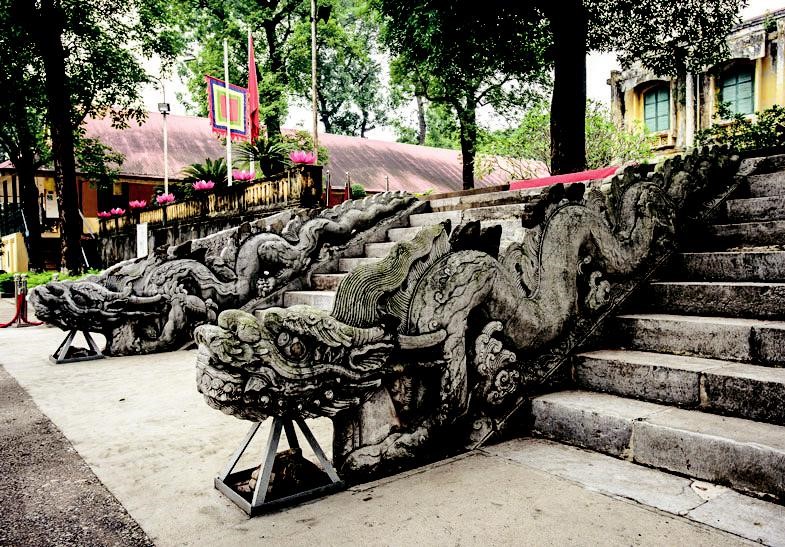
Photo: Tung Chau - Text: Thi Nguyen (Based on HOANGTHANHTHANGLONG.VN, GIACNGO.VN)



Hot news





Buy Baggage, meals, choose seats and more…
Luxury service
About Vietjet
Contact Center
Where to buy ticket?
Cargo
Privacy policy
Cookie Policy


