Booking
 Skyshop
 Hotel
Hotel
 E-Voucher
 E-Sim
E-Sim
 E-Visa
 Buy foreign currency
 Insurance
 SkyJoy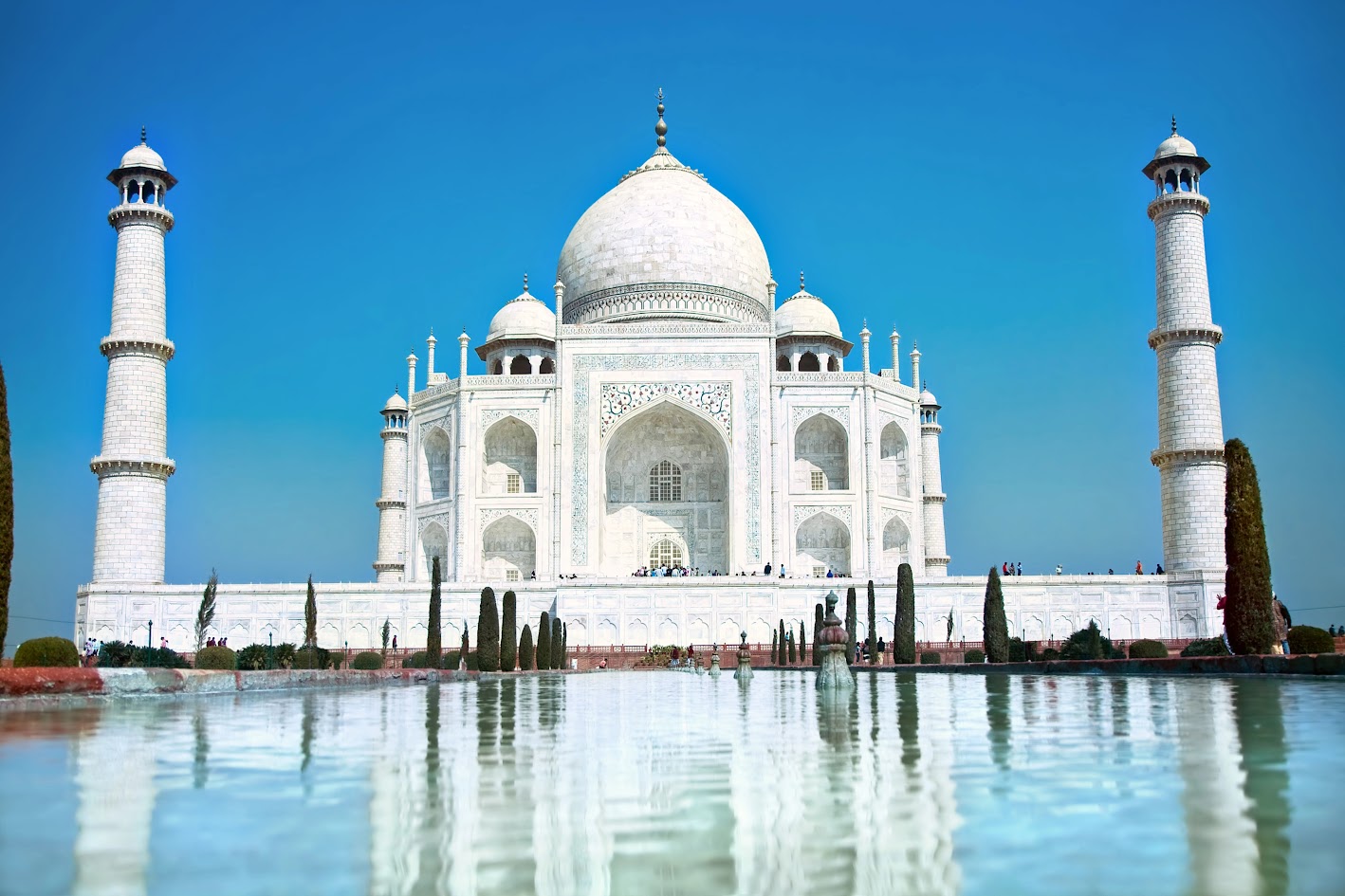
The Taj Mahal is a grand architectural structure, recognized as one of the New 7 Wonders of the World and a source of pride for the people of India. Moreover, it holds a romantic love story and immense historical value.
When traveling to India, a visit to the Taj Mahal is a must to witness this masterpiece of human creation. Join Vietjet to discover the special features of this magnificent temple!
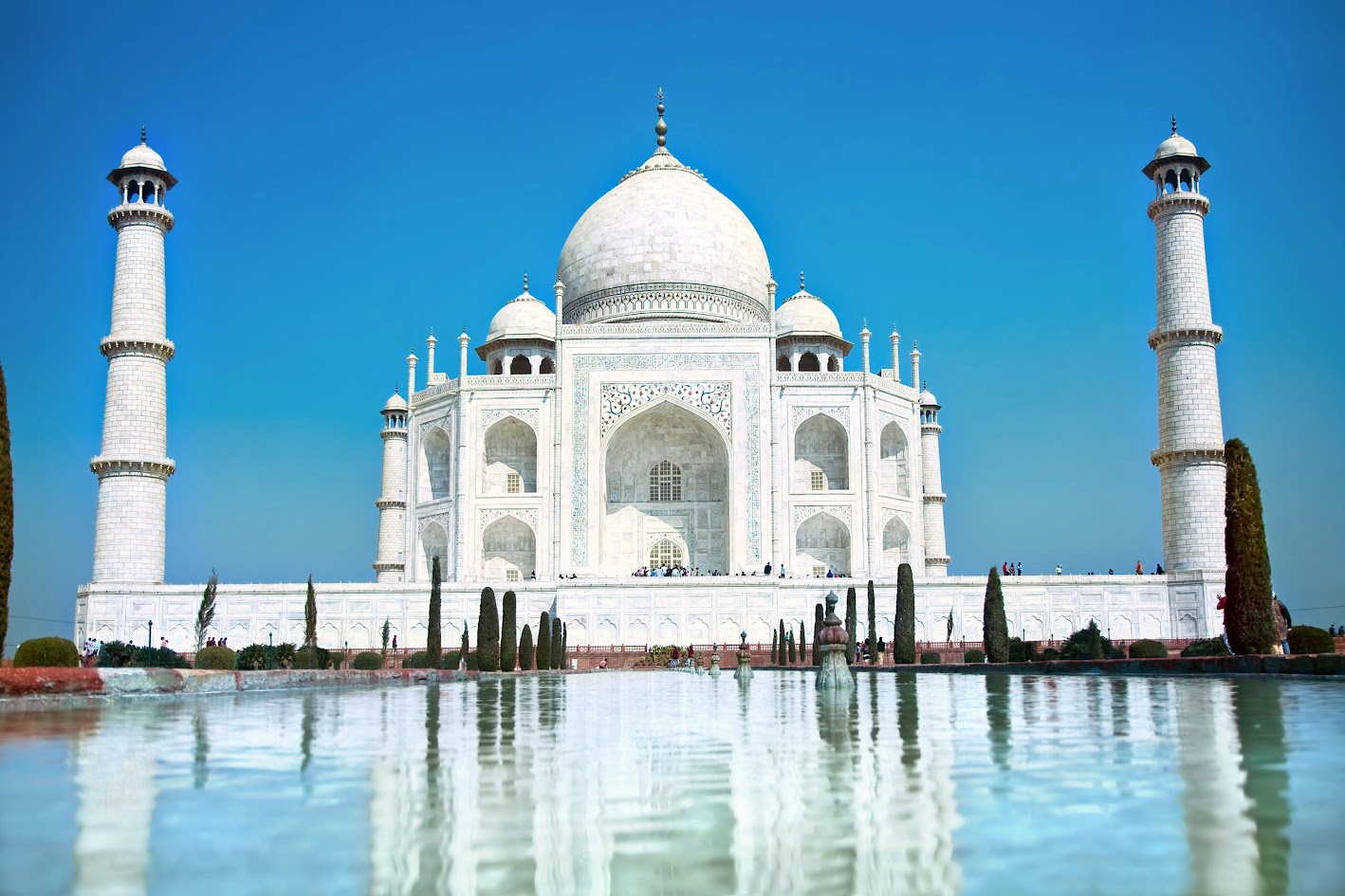
The Taj Mahal is one of the New 7 Wonders of the World.
1. Where is the Taj Mahal Located?
The Taj Mahal is situated on the banks of the Yamuna River in Agra, Uttar Pradesh, in northern India. This temple is actually a mausoleum built by the Mughal Emperor Shah Jahan in memory of his beloved late wife, Mumtaz Mahal. Hence, the structure is also regarded as a symbol of everlasting love.
Construction of the Taj Mahal began in 1632 and was completed in 1648, covering a vast area of 17 hectares. The renowned Iranian architect, Ustad Tsa, designed the Taj Mahal, which was built with contributions from 20,000 workers and artisans considered to be the best in the fields of stone inlay, carving, and dome construction. Notably, more than 1,000 elephants were used to transport materials from various regions both within and outside of India to create this magnificent temple.
2. Visiting the Taj Mahal, India
2.1 When is the Best Time to Visit the Taj Mahal?
The ideal time to visit the Taj Mahal is from March to September, when Agra's weather is most pleasant, with neither intense heat nor rain.
The Taj Mahal is open to visitors every day except Fridays, from 6:00 AM to 7:00 PM. However, the monument is most enchanting at two times: sunrise and sunset. Be sure to plan your visit accordingly so as not to miss these magical moments. On full moon nights, the Taj Mahal opens in the evening for visitors to enjoy the moonlight, though this does not apply during the month of Ramadan.

The Taj Mahal is most mesmerizing at sunrise and sunset.
See More: Pilgrimage Tours to India - A Spiritual Journey to the Land of the Buddha
2.2 How to Get to the Taj Mahal
First, book a flight to India, specifically to the capital, New Delhi. Check out Vietjet’s flights to New Delhi starting from just 688,000 VND at: https://www.vietjetair.com/vi/ve-may-bay/ve-may-bay-di-new-delhi/.
The Taj Mahal is located about 200 km from central India. If departing from Delhi, you can take the Yamuna Expressway, which takes around 3 hours to reach the Taj Mahal. You can also choose to travel by taxi or bus. Another option is by train, where you can book tickets to Agra and stop at Agra Cantonment, Agra Fort, or Agra stations.
Upon arriving in Agra, you can take an Auto Rickshaw to visit the Taj Mahal. Prices range around 15 Rupees per kilometer (approximately 4,500 VND/km). It’s advisable to ask for the fare in advance and negotiate for the best price.
3. The Origin of the Taj Mahal
The Taj Mahal (also known as the Taj Mahal Mausoleum) is a testament to an eternal love story. Shah Jahan’s third wife, Mumtaz Mahal, who was his most cherished, tragically passed away at the age of 39 after giving birth to their 14th child. This event left the emperor heartbroken, and his hair turned white overnight.
Before her passing, the queen asked the emperor to promise her: "Your Majesty, please build a mausoleum worthy of our love." The emperor was determined to fulfill this promise and dedicated much of his remaining life to constructing the Taj Mahal. Initially, the mausoleum was named "Tat Bibica Rauza," meaning "Tomb of the Queen of Hearts." Later, it was renamed "Taj Mahal," which in Persian means "Crown of the Mogul.
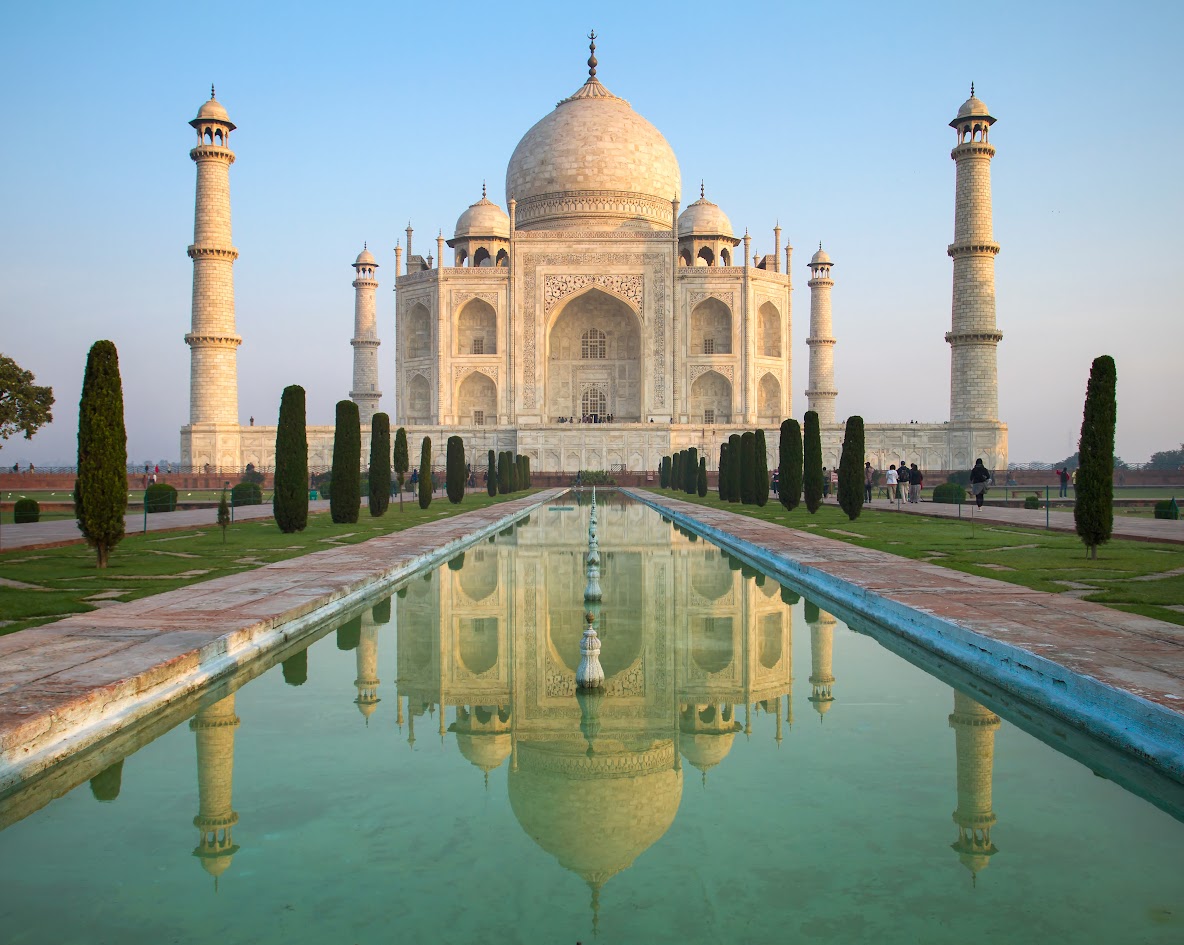
The Taj Mahal (Taj Mahal Mausoleum) is a testament to an eternal love.
4. Discover the Taj Mahal - A Masterpiece of Human Architecture
The Taj Mahal in India is an exquisite architectural marvel with its pure white marble standing out against the lush greenery and blue sky. Featuring the distinctive Mughal architecture, the Taj Mahal is a unique blend of Islamic and Hindu artistry, with intricate, harmonious details, especially the graceful curves of its domes, arches, and columns.
4.1 Overview of the Taj Mahal's Architecture
The Taj Mahal is designed with perfect symmetry on a square foundation. The complex consists of five main sections: Darwaza (the main gate), Bageecha (the garden), Masjid (the mosque), Naqqar Khana (the guest house), and Rauza (the Taj Mahal mausoleum). On either side are mosques, with the main temple in the center featuring symmetrically aligned domes, with the largest and tallest dome at the center.
The beauty of the Taj Mahal lies in the delicate combination of solid materials and precious stones, creating meticulously crafted concave and convex spaces that reach a level of supreme aesthetic. The stone pillars, each just 3cm square, are intricately inlaid with up to 50 gemstones. The floor is also paved with marble, arranged in alternating black and white squares.
The temple stands approximately 80 meters high. Each of the four corners features 40-meter-high towers. In Islamic belief, the number 4 symbolizes sanctity and eternity.

The Taj Mahal is a unique blend of Islamic and Hindu artistry.
4.2 The Changing Colors of the White Marble Temple
What makes the Taj Mahal even more magnificent and splendid is the way it reflects sunlight. The temple is adorned with various colorful gemstones and semi-precious stones embedded in white marble, so as the sunlight and weather change, the stones gradually change colors. At times, the temple appears bright white, at others pale yellow, and sometimes earthy brown.
4.3 The Tombs of the Emperor and Empress
Inside the large chamber on the second floor lie the tombs of Emperor Shah Jahan and Empress Mumtaz Mahal. The eight sides of each tomb are adorned with a lattice of white marble inlaid with 12 types of colorful gemstones, featuring elegant decorative patterns.
Since the mausoleum was built by the emperor in memory of Empress Mumtaz Mahal after her death, her tomb is placed at the center. Emperor Shah Jahan was later laid to rest beside his beloved wife. As a result, the two tombs are not aligned symmetrically—a unique asymmetry in the mausoleum.
However, these tombs are replicas of the actual burial chamber below. Thanks to small finger-sized holes carved into the stone walls, the interior of the mausoleum remains well-ventilated and not too dark.
4.4 The Garden
The Taj Mahal complex is set within and outside a large charbagh (a traditional Mughal garden divided into four parts). Spanning 320m x 300m, the garden has elevated walkways dividing each section into 16 flowerbeds or low flower plots. The garden serves as a grand entrance leading to the magnificent temple.
At the center is a marble pond aligned along the north-south axis, reflecting the image of the Taj Mahal. The garden is lined with rows of trees and fountains, creating a romantic and poetic scene.
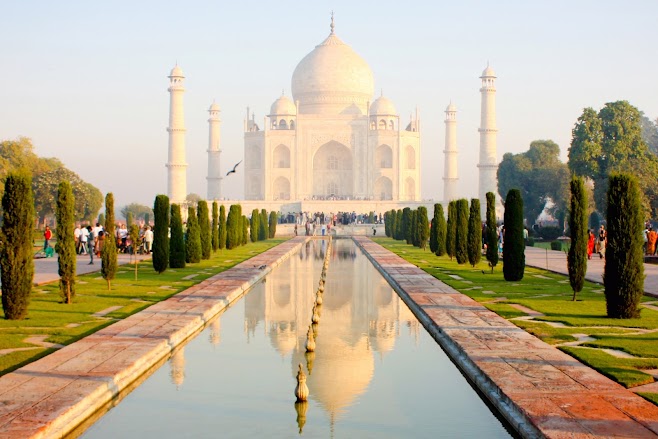
The garden serves as a grand entrance leading directly to the temple.
5. Tips for Visiting the Taj Mahal
Here are some tips for visiting the Taj Mahal:
- You will need to purchase a ticket to enter the temple. The ticket price is 1,100 Rupees (approximately 330,000 VND). Children under 15 are free.
- The ticket is valid for day visits and includes free drinking water, a map, and shoe covers for entering the temple. Tickets are available at the East, South, and West gates of the temple.
- Food, cigarettes, headphones, phone chargers, and similar items are not allowed. Additionally, photography is not permitted in the main mausoleum.
- Choose modest and respectful clothing. Dark-colored outfits can help you stand out against the white marble of the Taj Mahal.
- To enter the inner temple area, you must either wear single-use shoes provided by the management or go barefoot and place your shoes in the shoe covers provided.
These insights and tips for visiting the Taj Mahal, India, will hopefully be helpful for your trip. Don’t miss the chance to book flights to India at unbeatable prices at https://www.vietjetair.com/vi/ve-may-bay/ve-may-bay-di-new-delhi/. Vietjet currently offers 0 VND ticket deals every Friday—check it out HERE.
See More: What to Eat, Where to Go, and Tips for Finding Cheap Flights When Traveling to India
Don’t forget to follow Vietjet for the latest travel updates and special offers:
- Website: https://www.vietjetair.com
- Facebook: https://www.facebook.com/vietjetvietnam
- Instagram: https://instagram.com/vietjet
- YouTube: https://www.youtube.com/VietjetOfficial
- TikTok: https://www.tiktok.com/@vietjetvietnam
- Zalo: https://oa.zalo.me/vietjet